
The Renaissance Florence

The Renaissance Florence

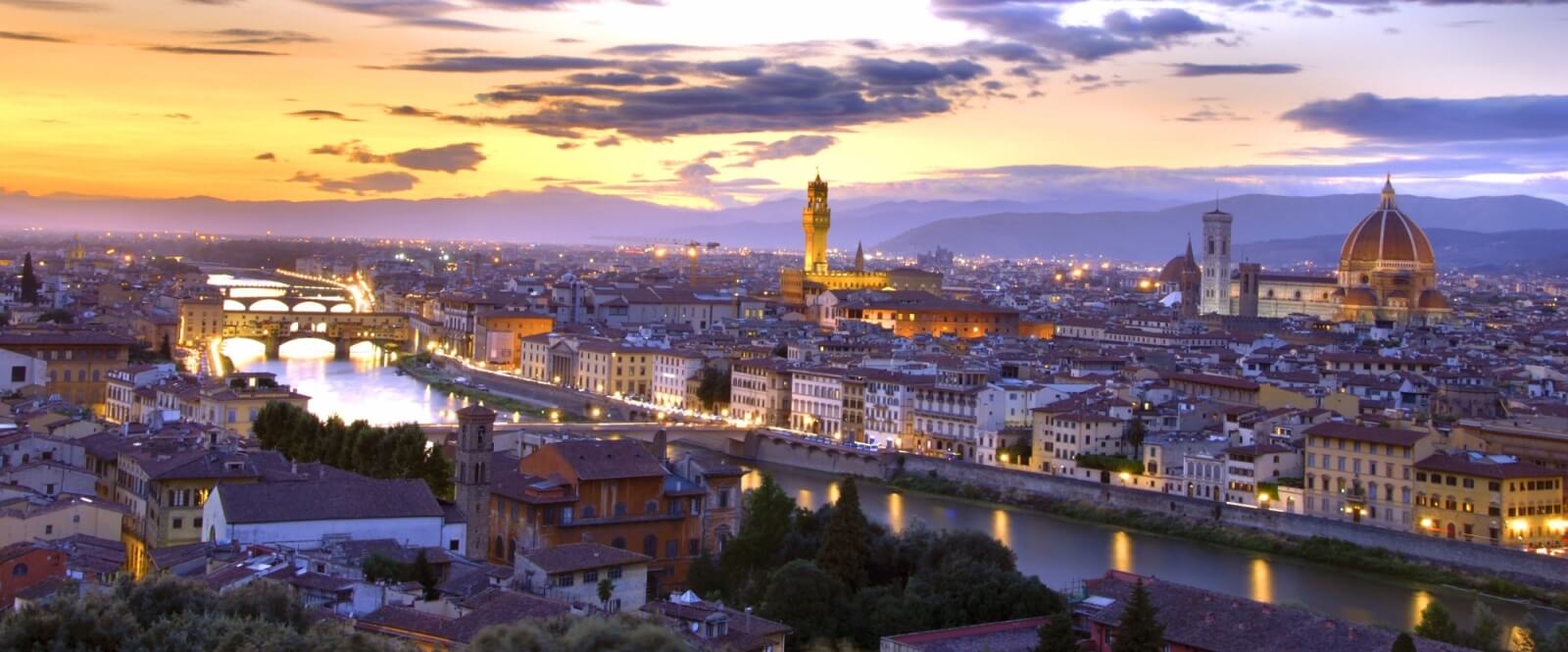
The best-know site and crowning architectural jewel of Florence is the domed cathedral of the city, Santa Maria del Fiore, known as The Duomo. Filippo Brunelleschi built this magnificent dome.

The nearby Campanile tower (partly designed by Giotto) and the Baptistery buildings are also highlights. Both the dome itself and the campanile are open to tourists and offer excellent views; the dome, 600 years after its completion, is still the largest dome built in brick and mortar in the world.

The Arno River, which cuts through the old part of the city, is as much a character in Florentine history as many of the men who lived there. Historically, the locals have had a love-hate relationship with the Arno-which alternated from nourishing the city with commerce, and destroying it by flood.

One of the bridges in particular stands out as being unique – The Ponte Vecchio (Old Bridge), who’s most striking feature, is the multitude of shops built upon its edges, held up by stilts. The bridge also carried Vasari‘s elevated corridor linking the Ufizzi to the Medici residence (Palazzo Pitti). First constructed by the Etruscans in the ancient times, this bridge is the only one in the city to have survived World War II intact.

The San Lorenzo contains the Medici Chapel, the mausoleum of the Medici family – the most powerful family in Florence from the 15th to the 18th century.

Nearby is the Uffizi Gallery, one of the finest art galleries in the world – founded on a large bequest from the last member of the Medici Family. The Uffizi (“offices”) itself is located on the corner of Piazza della Signoria, a site important for being the center of Florence civil life and government for centuries (Signoria Palace is still home of the community government): the Loggia dei Lanzi was the set of all the public ceremonies of the republican government. Many will know episodes of history of art and political changes were staged here, such as:

  • In 1301, Dante was sent into Exile from here (a plaque on one of the walls of the Uffizi commemorates the event)
  • 26 April 1478 Jacopo de‘Pazzi and his retainers tried to raise the city against the Medici after the plot known as The congiura dei pazzi (The pazzi conspiracy) who murdered Giuliano dei Medici and wounded his brother Lorenzo; the Florentines seized and hung all the members of the plot than could be apprehended from the windows of the Palace.
  • In 1497, it was the location of the Bonfire of the Vanities instigated by the Dominican friar and Preacher Girolamo Savonarola
  • The 23 of May 1498 the same Savonarola and two followers were hanged and burnt at the stake (a round plate in the ground commemorates the very spot were he was hanged)
  • In 1504, it was the original location of Michelangelo‘s David (now replaced by a re production as the original was moved indoors to the Academia dell‘Arte del Disegno), in front of the Palazzo della Signoria (also know as Palazzo Vecchio). It is still the setting for a number of statues by other sculptors such as Donatello, Giambologna, Cellini, Ammannati, although some have been replaced with copies to preserve the priceless originals.

In addition to the Uffizi, Florence has other world-class museums. The Bargello concentrates on sculpture, containing many priceless works of art created by such sculptors as Donatello, Giambologna and Michelangelo.

The Academia dell‘Arte del Disegno (often simply called the Accademia) collections’ highlights are Michelangelo‘s David and his unfinished Slaves. Across the Arno is the huge Pitti Palace containing part of the Medici family‘s former private collection.

In addition to the Medici collection the palace‘s galleries contain a large number of renaissance works, including several by Raphael and Titian as well as a large collection of modern art, costumes and porcelain. Adjoining the Palace are the Boboli Gardens, elaborately landscaped and with many interesting sculptures.

The Santa Croce basilica, originally a Franciscan foundation, contains the monumental tombs of Galileo, Michelangelo, Machiavelli, Dante (actually a cenotaph, and many others notables.

Other important basilicas and churches in Florence include Santa Maria Novella, San Lorenzo, Santo Spirito and the Orsanmichele. Florence has been the setting for numerous works of fiction and movies, including the novels and associated films Hannibal, Tea with Mussolini and A Room with a View Today, the city is so rich in art that some first time visitors experience the Stendhal syndrome as they encounter its art for the first time.

Stay in touch

Need more information? Write us at: bottaccio@bottaccio.com
or call on +39 0585 340031

Accessibility
close
Accessibility Information

Together with our selected providers, we are committed to ensuring that our services are accessible to people with disabilities. We devote significant resources to ensure that our website and room booking pages are easier to use and more accessible for individuals with disabilities, based on the strong belief that everyone has the right to live with dignity, equality, comfort, and independence.

Along with our partners, we continuously strive to improve the accessibility of our website and the pages for booking rooms and/or purchasing additional products and services related to the stay. We firmly believe it is our collective moral obligation to allow seamless, accessible, and unhindered use, even for those of us with disabilities.

In our ongoing efforts to improve and consistently address accessibility issues, we regularly scan all web pages using accessibility scanners provided by third-party commercial partners to identify and fix any potential accessibility barriers on our site. Despite our efforts to make all our web pages and content fully accessible, some content may not yet have been fully adapted to the strictest accessibility standards. This may be due to not having yet found or implemented the most appropriate technological solution.

Compliance Status

This website and the room booking pages are partially compliant with the technical standard for websites and mobile applications UNI CEI EN 301549, and with the “AA” accessibility level required by the Web Content Accessibility Guidelines (WCAG) 2.1.
In particular, the compliance level of this website is constantly monitored through the tools provided by:
https://mauve.isti.cnr.it/
https://pagespeed.web.dev/

Non-accessible Content

Despite our efforts to ensure the accessibility of the website and booking pages, we are aware of some limitations we are working to resolve. Below is a description of the known limitations. Please contact us if you encounter an issue not listed below.

  • Image text alternatives: Some images do not have meaningful text alternatives for users.
  • Reading order: Due to the modular structure of some pages, the reading order of elements may not match their visual order.
  • Focus contrast: In some cases, when elements receive focus, there may be insufficient contrast between text color and background.
  • Keyboard operability: Some components cannot be operated using only a keyboard.
  • Animated content: Some pages contain animated content that cannot be paused or hidden.
  • Focus visibility: In some pages, the element with active focus is not visually identifiable.
  • Language accessibility: Some elements display text or accessible names only in certain languages.
  • Assistive technology: Assistive technologies may not always correctly announce messages.

Last Updated

This page on accessibility was last updated on June 25, 2025.