
Lucca and Montecarlo

Lucca and Montecarlo

“ Lucca…a compact and admirable little city, the very model of a small pays de Cocagne, overflowing with everything that makes for ease for plenty, for beauty, for interest and good example” (Henry James, “Italian Hours”) .

LUCCA

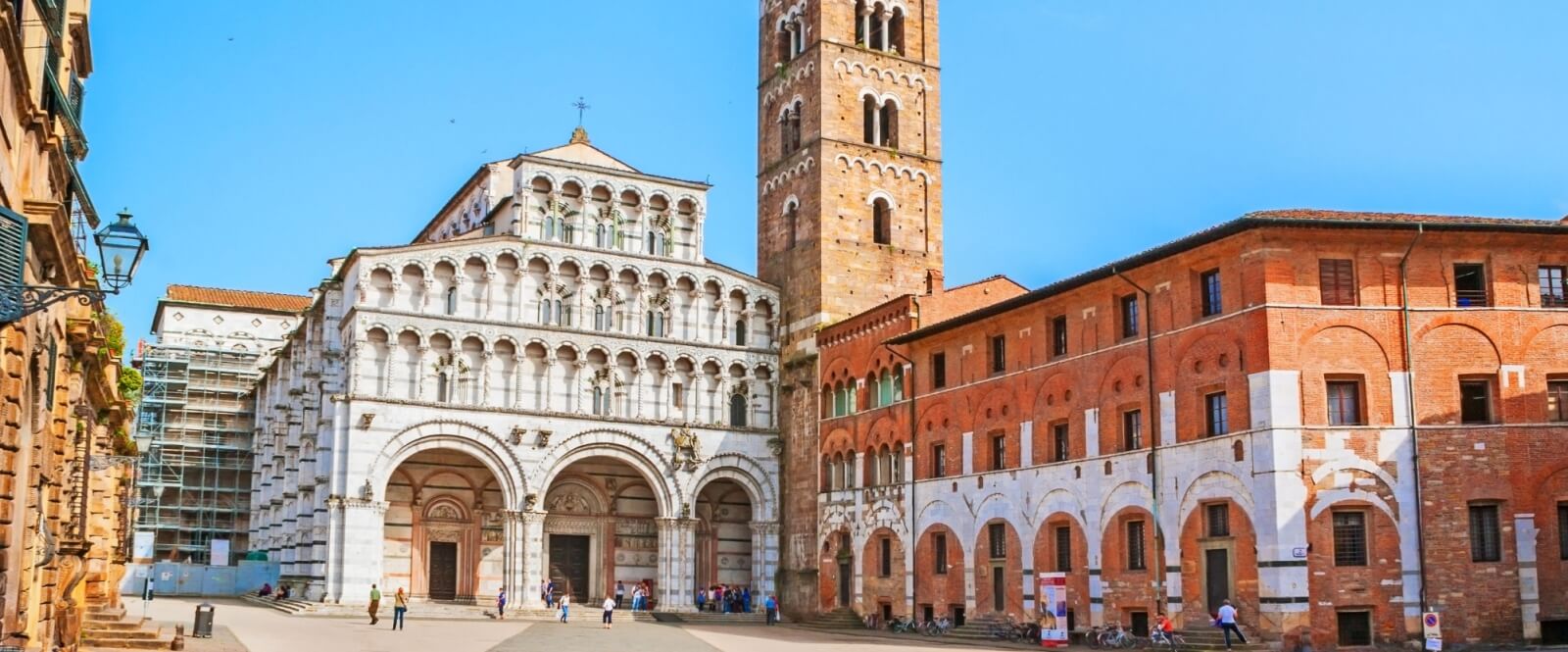
This quaint and evocative city retains the charm of a small and ancient Italian City State. Over the centuries it has managed to hold on its independence and freedom by adopting an cautious policy.

Having miraculously escaped the devastation of the war, today it boats one of the most extraordinary Tuscan and heritage. The imposing tree-lined Renaissance walls, which totally enclose it, the maze of medieval streets, flange by towers and smart boutiques, the enchanting Romanesque churches and bright inviting squares captivate the visitor who stands in awe of such unexpected beauty.

  • Piazza Anfiteatro, built on the ruins of the ancient Roman arena, is still today one of the most picturesque landmarks of the town
  • Guinigi Tower, one of its kind has a very suggestive tree lined hanging garden right on the top
  • Basilic di San Frediano, Is one of the most ancient churches in Lucca famous for the splendid gilded mosaic on the façade
  • The 16th century Walls, built for defence reasons, are today a public garden for the enjoyment of all. You can take a leisurely stroll, ride your bike or even take a ride on a carriage to better appreciate their beauty.

PALACES AND MUSEUMS:

It is possible to change or extend the city tour including a visit to some of the most beautiful “Palazzi” belonging to the merchants of Lucca

  • Palazzo Mansi, one of the most important noble palaces in Lucca. Elaborately furnished, is the symbol of wealth archived by the mercantile families of Lucca, Today it is The historical center, now a pedestrian precinct, plunges the visitor back in time and provides the perfect setting to savour the old warm charm, where time and space take on a new dimension, no longer found in today‘s modern cities.

WHAT TO VISIT:

  • Piazza S. Michele in Foro, to admire the church bearing the same name
  • Piazza Napoleone, from this square we can admire Palazzo Ducale and Teatro del Giglio (the theatre) • Cathedral San Martino, important destination for medieval pilgrims who came here to worship “Il Volto Santo” (The holy Countenance of Christ), is still today an important symbol of the city. Inside the sacristy is the renowned sarcophagus of Ilaria del Carreto by Jacopo della Quercia. A definite must (admission fee)
  • Characteristic medieval streets, worthy of mention is “via degli antiquari” where we can see the fine antique shops and the teeming and smart Via Fillungo. the National Museum which houses paintings from the 16th to the 20th centuries
  • Villa Guinigi, an ancient Gothic villa that belonged to the Guinigi family. Today is a National Museum witch houses in two halls, paintings and sculptures from Lucca and its territory from the very origins to the 18th century
  • Palazzo Pfanner, is one of the few city palaces witch boats a Baroque garden of exceptional beauty, probably designed by Filippo Juvarra. The perspective of the hedges and allegorical statues recreates the typical stage settings of the late 17th century. It is also possible to visit the palace inside
  • Palazzo Ducale, this is the government palace of the Republic of Lucca designed by Bartolomeo Ammannati. In the 16th century, the interior was completely renovated in the Neo-Classical style and later became the residence of the Princess Elisa Baciocchi Bonaparte. It is today the “Prefettura” and the local provincial administration.

MONTECARLO (LUCCA)

Montecarlo’s urban set-up is organized around parallel and perpendicular main streets, and it is enclosed by fortified walls, towered over by the majestic Belfry of the Collegiate of Sant’Andrea, visible from the whole surrounding plain. Of the fourteenth-century gates placed along the walls there remain Porta Fiorentina (the 15th century Florentina Gate, modified in the 16th century) to the east, the Porticciola (the 14th century Lucca Gate) to the west towards Lucca, which was widened in 1594, while Porta Nuova (or New Gate) to the south was reopened at the end of the sixteenth century.

On the main street, formerly via Grande and today Via Roma, we encounter the Collegiate Church of Sant’Andrea. In nearby via Carmignani we find the Municipal Theatre of the Rassicurati. The well-preserved town walls, attached to the fortress, can be still admiredtoday. These walls also include the three main town gates.

Stay in touch

Need more information? Write us at: bottaccio@bottaccio.com
or call on +39 0585 340031

Accessibility
close
Accessibility Information

Together with our selected providers, we are committed to ensuring that our services are accessible to people with disabilities. We devote significant resources to ensure that our website and room booking pages are easier to use and more accessible for individuals with disabilities, based on the strong belief that everyone has the right to live with dignity, equality, comfort, and independence.

Along with our partners, we continuously strive to improve the accessibility of our website and the pages for booking rooms and/or purchasing additional products and services related to the stay. We firmly believe it is our collective moral obligation to allow seamless, accessible, and unhindered use, even for those of us with disabilities.

In our ongoing efforts to improve and consistently address accessibility issues, we regularly scan all web pages using accessibility scanners provided by third-party commercial partners to identify and fix any potential accessibility barriers on our site. Despite our efforts to make all our web pages and content fully accessible, some content may not yet have been fully adapted to the strictest accessibility standards. This may be due to not having yet found or implemented the most appropriate technological solution.

Compliance Status

This website and the room booking pages are partially compliant with the technical standard for websites and mobile applications UNI CEI EN 301549, and with the “AA” accessibility level required by the Web Content Accessibility Guidelines (WCAG) 2.1.
In particular, the compliance level of this website is constantly monitored through the tools provided by:
https://mauve.isti.cnr.it/
https://pagespeed.web.dev/

Non-accessible Content

Despite our efforts to ensure the accessibility of the website and booking pages, we are aware of some limitations we are working to resolve. Below is a description of the known limitations. Please contact us if you encounter an issue not listed below.

  • Image text alternatives: Some images do not have meaningful text alternatives for users.
  • Reading order: Due to the modular structure of some pages, the reading order of elements may not match their visual order.
  • Focus contrast: In some cases, when elements receive focus, there may be insufficient contrast between text color and background.
  • Keyboard operability: Some components cannot be operated using only a keyboard.
  • Animated content: Some pages contain animated content that cannot be paused or hidden.
  • Focus visibility: In some pages, the element with active focus is not visually identifiable.
  • Language accessibility: Some elements display text or accessible names only in certain languages.
  • Assistive technology: Assistive technologies may not always correctly announce messages.

Last Updated

This page on accessibility was last updated on June 25, 2025.